 015242 71334
 admin@stmarys-kl.cumbria.sch.uk


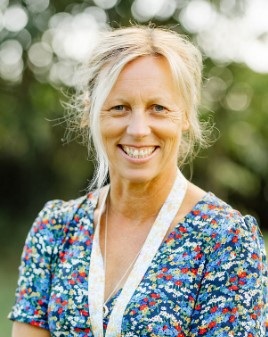
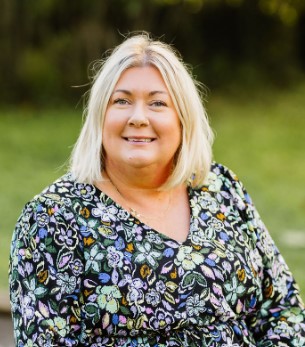
A warm welcome from our EYFS Teachers.
Intent
At St. Mary’s, we provide an ambitious, motivating, and stimulating early years curriculum that establishes the strong foundations children need to succeed. We recognise that every child is unique, celebrating the diversity within our school community and instilling a deep sense of belonging. Building on learning from home and previous settings, our curriculum is rooted in an accurate baseline understanding of each cohort and individual child. While our broad curriculum is carefully planned and sequenced, our inspiring, expert EYFS team dynamically responds to children’s emerging needs, starting points, and interests to ensure every child thrives.
We nurture resilient, inquisitive, and ambitious learners who embrace challenges and develop a lifelong love of learning. Grounded in the Characteristics of Effective Learning, our provision encourages children to explore, take risks, solve problems, and grow in confidence and independence within a safe, enabling environment.
Through high-quality adult-child interactions and rich learning experiences both indoors and outdoors, we ignite curiosity and broaden horizons. Cooperative and collaborative learning are at the heart of our practice, with a sharp focus on the prime areas: Personal, Social and Emotional Development, Physical Development, and Communication and Language. We place particular emphasis on oracy—modelling ambitious vocabulary and developing confident talk—as a foundational life skill that underpins future academic success and readiness for the next stage of education.
In partnership with parents and carers, we share and celebrate every milestone in each child’s unique journey. Our ultimate intent is for all children including those with SEND, to secure essential foundational knowledge, achieve the Early Learning Goals, and make a seamless, confident transition into Key Stage 1 and beyond.
It is our intent for all children to reach the Early Leaning Goals at the end of the Foundation Stage as well as ensuring a smooth transition into the next Key Stage.
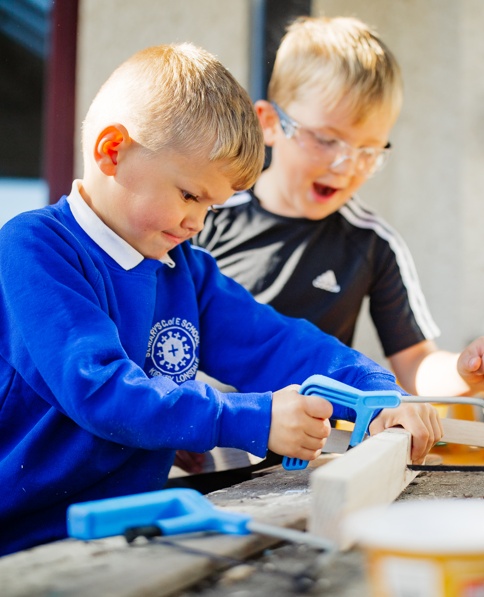
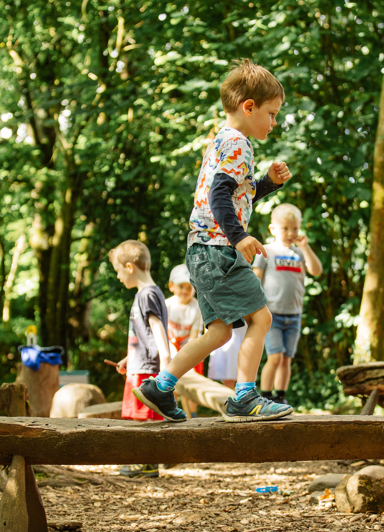
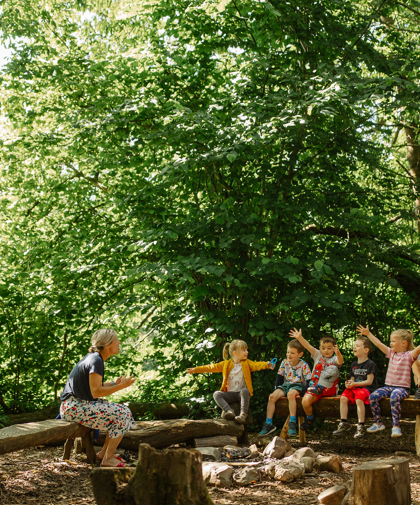
Implementation
Our approach is influenced by the work of educationalists, researchers, psychologists and practitioners who have guided our knowledge of how young children learn and how adults can support their learning.
St.Mary’s provision is underpinned by a complementary relationship between adult led, adult-initiated and child led learning.
We are ambitious in our approach using a continuous cycle of observation and assessment, planning/teaching, alongside structured and systematic lessons and guided group work.
Throughout EYFS at St Mary’s, we follow the Early Years Statutory Framework for the Early Years Foundation Stage, updated in September, 2021, by the DfE. This framework specifies the requirements for learning and development in the Early Years and provides prime and specific areas of learning.
We have a curriculum that is child-centred and that is based on themes which engage the children. We encourage active learning to ensure that the children are motivated and interested. We take time to get to know the children’s interests and their likes to support learning. All areas of the EYFS curriculum are planned for to ensure that there is a broad, balanced and progressive learning environment and curriculum.
The children will learn new skills, acquire new knowledge and demonstrate understanding through the seven areas of the EYFS curriculum:
- Personal, Social and Emotional Development
- Physical Development
- Communication and Language
- Literacy
- Mathematics
- Understanding the World
- Expressive Arts and Design
Weaving throughout the EYFS curriculum at St.Mary’s are three Characteristics of Effective Learning.
• playing and exploring – children investigate and experience things, and ‘have a go’
• active learning – children concentrate and keep on trying if they encounter difficulties, and enjoy achievements
• creating and thinking critically – children have and develop their own ideas, make links between ideas, and develop strategies for doing things
These elements underpin how we reflect on each child’s development and adjust our practice accordingly. Supporting children in their individual learning behaviour and observing the context of children’s play is essential.
Linked provision
Each day children experience sessions of engaging, active learning linked to their next steps.
Adult led focused groups
Whole class shared input is used in Nursery and Reception throughout the day when felt appropriate, this could be to introduce a new theme, feedback on learning from the day, share a story or ask a visitor questions.
Short focused groups are planned for writing, reading and maths and immediately follow a shared input. These sessions are planned with care, meeting the needs of all children, using prior knowledge of the child’s learning experiences and guidance from the EYFS framework (DfE).
Daily guided activities are also planned to cover different areas of the curriculum and allow children to develop their next steps in learning. The timetable is carefully structured so that children have rigorous, directed teaching in Maths and Phonics each day in Reception and when developmentally appropriate in Nursery. These sessions are followed by group work with a member of staff.
Continuous Provision
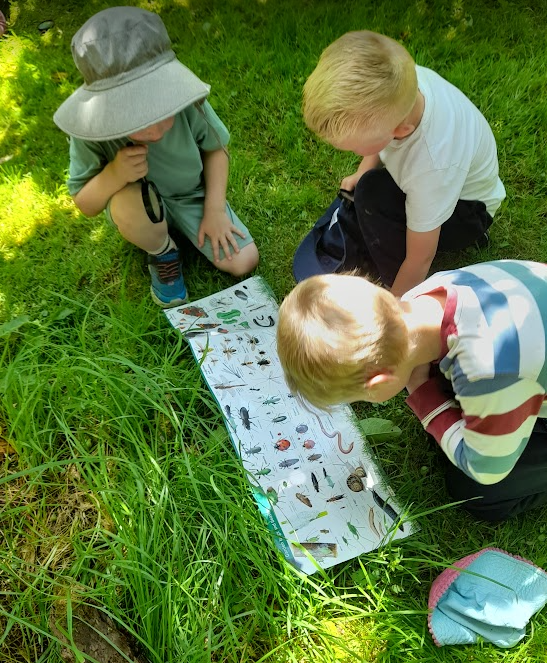
Both across our natural indoor classrooms and inspiring outdoor areas—provides an enabling environment tailored directly to our baseline assessments of each unique cohort. These intentionally designed spaces allow children to safely explore independently, taking ownership of their discovery while developing key foundational skills. Crucially, our continuous provision allows children to revisit their inquiries, returning to their learning over extended periods to deepen their understanding.
Flowing seamlessly across all seven areas of learning, our provision creates rich opportunities for children to demonstrate the Characteristics of Effective Teaching and Learning. Surrounded by authentic, open-ended materials, children are given the freedom to make independent choices, act as curious, active learners, and shape their own educational journey.
Our thoughtfully adapted environments—combined with deep practitioner knowledge—enable staff to join children in play to scaffold next steps, stretch potential, and consolidate prior learning. This self-directed discovery means children daily apply and refine taught skills throughout the year. In doing so, they cultivate vital life competencies including independence, resilience, natural curiosity, creativity, critical inquiry, and collaborative problem-solving alongside peers and caring adults.
Assessment
- Observation
Throughout ‘continuous provision’ observation forms a fundamental aspect of the pedagogy of EYFS at St.Mary’s Primary School.
Observation and responding to children’s thinking inform our planning of experiences and opportunities, how we create our environment for thinking, the strategies the adults use to extend learning (modelling, scaffolding, questioning, discussion, shared sustained thinking) and how we capitalise knowledge of children’s interests to ensure high levels of engagement. All adults record ‘Wow!’ moments – when a child does or says something that demonstrates progress or skill in a particular area.
A continuous cycle of observation, assessment and planning is embedded throughout our EYFS provision.
- Summative Assessments
In addition to the continuous cycle of observation and formative assessment which informs each child’s next steps, summative assessments are carried out for phonic development, the stable order principle in number and an assessment of each child’s stage of development for each of the 7 areas of learning. These take place termly and informs planning of subsequent teaching and learning.
The role of the adult
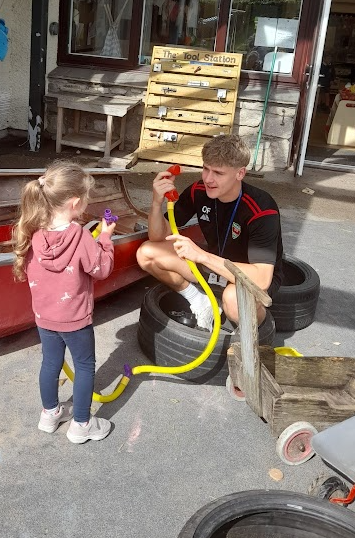
Evidence-based practice demonstrates that children make optimal progress when supported by skilled practitioners who act as positive role models within an enabling environment. In our setting, adult engagement begins with the principle of Wait, Watch, and Wonder, allowing staff to accurately gauge a child’s intent before joining their play. Interactions are deliberately structured to embed early oracy skills and facilitate Sustained Shared Thinking. Adults show genuine interest in children’s decisions, clarify and recap ideas, and gently challenge thinking by speculating alongside them. By scaffolding language, offering alternative viewpoints, and providing precise, value-added feedback, staff elevate children’s communication, reasoning, and self-regulation.
Interact, don’t interfere
The role of the environment
The importance of each adult to support progression is crucial however, we equally understand that in times when a child is on their own independent learning journey the environment plays a significant role in development.
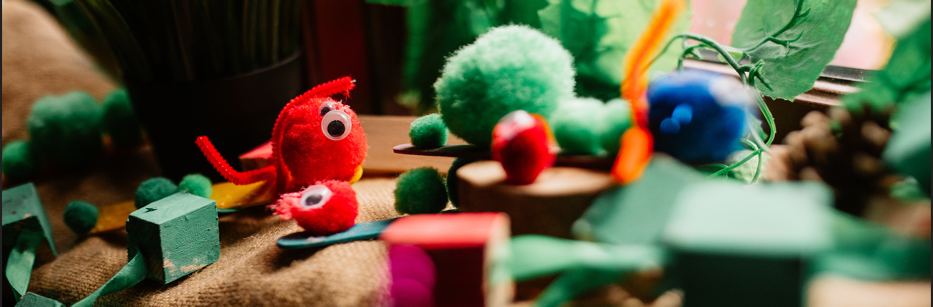
At St.Mary’s each area of the classroom is informed by assessment. As the needs of the children change, as they grow and develop, so does their learning space. Using resources that are open ended encourage creativity, imagination and high order thinking skills. These resources can become anything and have unlimited potential. Our timetable allows for long uninterrupted periods of continuous provision that allow the children time to reach a deep level of involvement as they engage, play, investigate and talk.
EYFS Curriculum
At St.Mary’s we follow the EYFS statutory framework. There are four guiding principles which shape our practice.
These are:
1. Every child is a unique child, who is constantly learning and can be resilient, capable, confident, and self-assured.
2. Children learn to be strong and independent through positive relationships.
3. Children learn and develop well in enabling environments with teaching and support from adults, who respond to their individual interests and needs and help them to build their learning over time. Children benefit from a strong partnership between practitioners and parents and/or carers.
4. Children develop and learn at different rates. The framework covers the education and care of all children in early years provision, including children with special educational needs and disabilities (SEND).
Early Reading and Phonics
Reading is at the heart of our curriculum. Our themes are focused around high quality stories and books. By delving into these texts we build vocabulary, find out about people and lands and inspire discussions and exploration. We explicitly teaching high quality vocabulary each week through stories and experience, then repeating the key words throughout the day/week/month/ term to ensure the learning is embedded. The children in Reception follow the rigorous and highly successful, Read, Write Inc programme, faithfully, making good progress in spelling, reading and writing.
Systematic synthetic phonics is taught using Read Write Inc Phonics scheme. Whole-class or small group teaching takes place daily.
Early sound discrimination skills are taught in Nursery and continue into Reception and KS1. In Nursery children are taught about:
• Environmental sounds, instrumental sounds, body percussion, rhythm and rhyme, alliteration, voice sounds and oral blending and segmenting
Read Write Inc phonics starts when children are ready. This might be in Nursery for some in the Spring/Summer term or the beginning of Reception.
Maths
In Maths in Nursery and Reception we follow the White Rose Maths scheme, which emphasises the deep and thorough understanding of number and number patterns required by the curriculum. Pupils learn through games, rhymes, outdoor learning, computer programmes and tasks using concrete manipulatives.
Assessment
Through observation and discussion, areas of need and next steps are identified for all children to ensure that good progress is made. In the EYFS, observations of the children’s learning and WOW moments are added to our online learning journeys. We regularly assess where the children are, using ‘Development Matters’ guidance, then ensure our planning, adult interactions and learning environment reflect our observations. These termly judgements are logged on the school’s online network, and the Early Years practitioners complete gap analysis grids which helps us to plan our future provision and ensure that children are working to meet their targets.
Additional Support
Our inclusive approach means that all children learn together but we have a range of additional interventions to support children who may not be reaching their full potential. This includes the WELLCOMM speech and language programme which focuses on early listening, attention and vocabulary acquisition; Move-to-Write improves gross and fine motor skills; and ‘Pinny-Time’ focuses on quick, on the spot interventions to boost the acquisition of letter sounds, number retention or colours, depending on the needs of the individual. One to one speech support is provided weekly by our Nursery and Reception practitioners under guidance from a Speech and Language specialist.
Parent/Carer Engagement
Parents/carers are the first and most important influence on their child’s development and future outcomes.
Children have two main educators in their lives – their parents/carers and their teachers. Therefore, the school and the parents/carers all have crucial roles to play. The impact on a child’s education is greater if parents/carers and schools work in partnership.
At St.Mary’s, parents/carers are invited to be involved in every step of a child’s journey in education. Beginning with a starting nursery or school visit, followed up with the invitation for their child to attend several ‘transition’ sessions before the term commences. ClassDojo is the way that we share your child’s most important learning moments through photos, videos and messages. We also share class information, photos of class activities and it’s a great way to communicate messages between staff and parents/carers. ClassDojo is then used throughout the school.
We pride ourselves on building positive relationships with the families of St.Mary’s. Creating a ‘triangle of trust’ (Elfer et al.) between children, parents/carers and practitioners. We understand that when parents/carers relinquish part of the care and teaching of their child to the staff in our setting it is a big step. We create an environment that is conducive to interactions where all feelings can be taken into account. A warm welcome each day often leads to a deeper knowledge and understanding of each child and their family.
Transitions
Transition from Nursery to Reception is a carefully planned next step. Adults work together to support children and parents with transition days, meetings and information. The children know the adults well before they start in Reception, whether this is children from our Nursery or from feeder nurseries e.g. SMILE. Parents are kept informed of the transition events and very much a part of the stage. Sharing the outdoor area helps children transition well from Nursery to Reception.
We also support the transition into Year 1 and Key Stage 1 for both the child and their parents. We prepare children for Year 1 with visits to their new class, meeting the teacher and ensuring that the environments are similar at the end of EYFS and the start of Year 1.
Impact
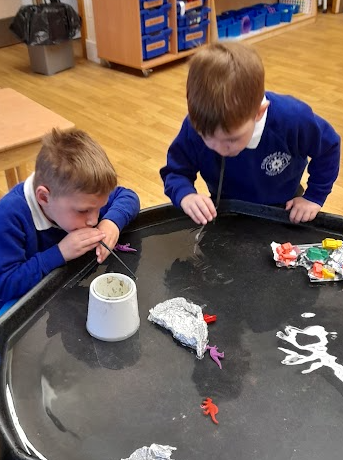
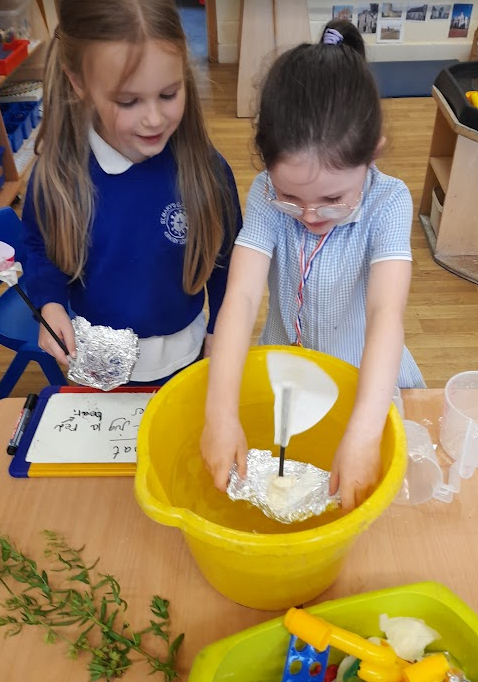
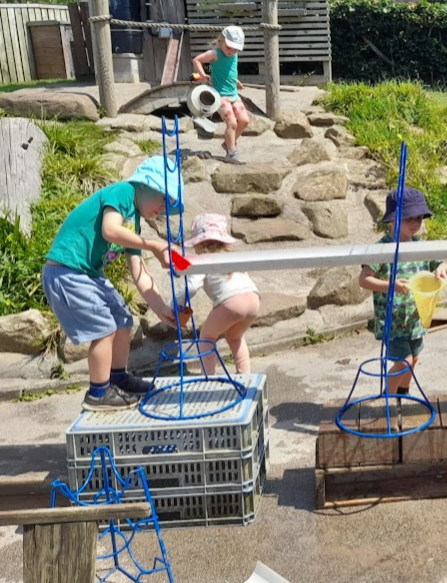
The impact of our EYFS curriculum at St. Mary’s School is reflected in having well rounded, happy and confident children who embody our school values and carry with them the knowledge, skills and attitudes which will make them lifelong learners and valuable future citizens.
We strive to ensure that our children’s progress across the EYFS curriculum is good from their varied starting points. We aim for children to reach the Early Learning Goals at the end of Reception and that all children are at least in line with National Expectations. We have consistently exceeded this.
Children will demonstrate high levels of engagement in activities, developing their speaking and listening skills, enabling them to access more areas of the learning and communicate to both adults and children. Children will develop skills across all areas of the curriculum including Literacy, Mathematics and Physical Development using these in different ways. Children will have developed a wider sense of the world around them and can draw on these experiences during interactions with others and link this to new learning. Children will have developed their Characteristics of Learning and be able to apply their knowledge to a range of situations making links and explaining their ideas and understanding. Children will be confident to take risks and be able to solve problems and work together with friends because of the rich and stimulating curriculum that has been put in place at St. Mary’s.
Children enter Key Stage One ready to begin the next chapter of the educational journey. They are equipped with a broad range of knowledge and skills that provide the right foundation for future progress through school and life.